
Funding opportunity briefing
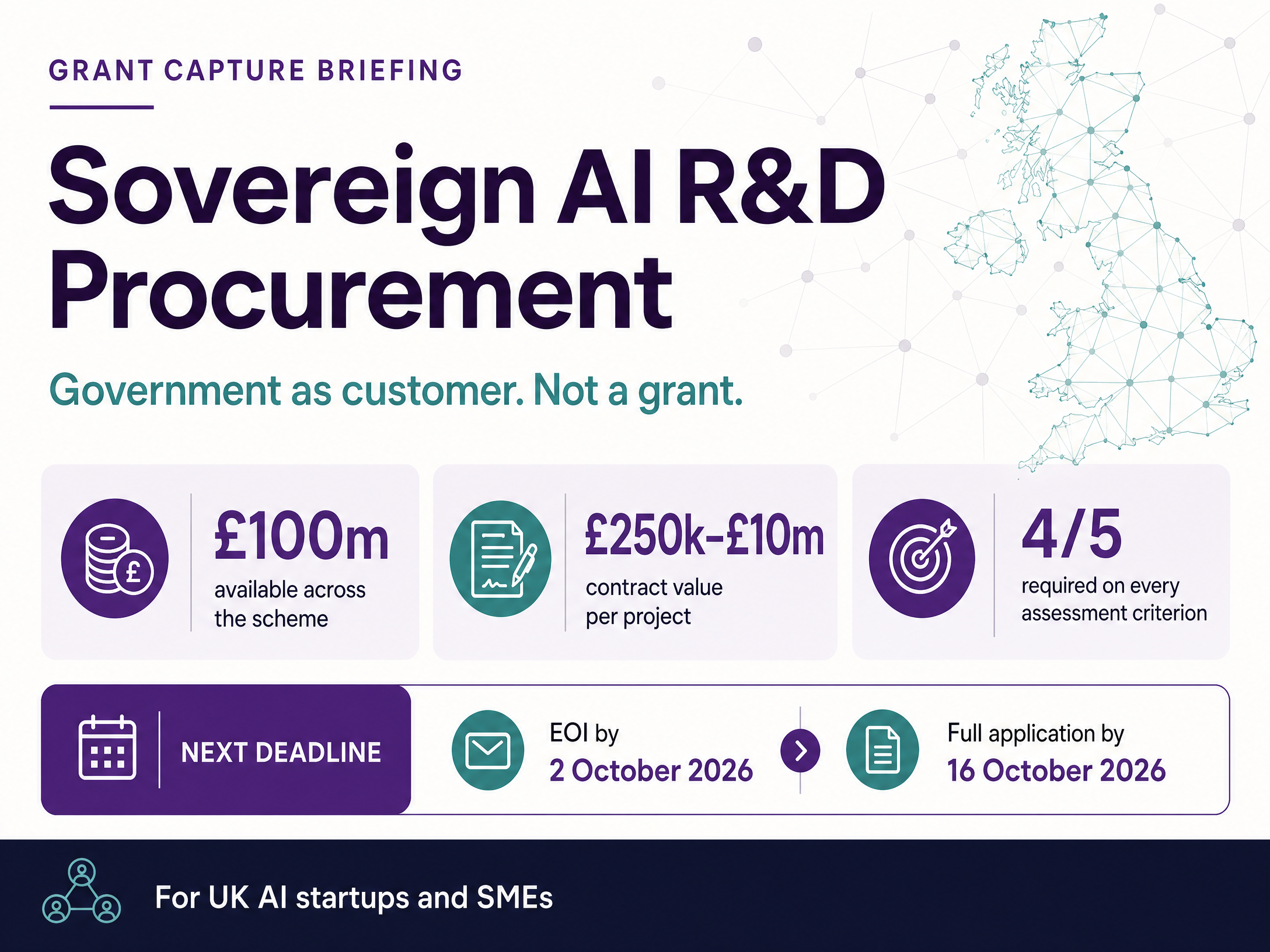
Up to £100 million is available for UK startups and small to medium-sized enterprises developing novel artificial intelligence capability against challenges set by government. The Sovereign AI R&D Procurement Scheme is a procurement route, rather than a grant. That distinction changes how an applicant needs to prepare.
Government is buying the design, development, testing and demonstration of AI capabilities that answer a defined public-sector problem. Successful suppliers establish a direct supplier-customer relationship with the relevant public-sector organisation, retain ownership of their background and foreground intellectual property, and are encouraged to commercialise the capability they develop.
Available
£100m
Across the lifetime of the scheme
Contract value
£250k to £10m
Most contracts are expected to be £1m to £3m
Development stage
TRL 4 to 8
Pre-commercial R&D, not routine deployment
Assessment gate
4 out of 5
Required on every criterion to progress
What the scheme is seeking
Four initial challenges are open, with further challenges expected over the life of the scheme. The current opportunity areas are AI for NHS productivity, integration of AI across defence mission environments, increased efficiency in public compute infrastructure, and safe AI-agent adoption.
AI for a more productive NHS
Capabilities that release capacity at scale by automating workflows, coordinating care or supporting decisions.
AI across defence mission environments
Open, secure and modular capabilities that can operate from enterprise systems to the edge.
Increased compute efficiency
Novel hardware or software to strengthen the efficiency of public compute infrastructure.
Safe AI-agent adoption
Evidence-led approaches to managing the resilience and cyber risk of agents in specific contexts.
The deadline behind the deadline
Full applications are assessed in competition batches every two months. Before submitting a full application, however, a company must join the Approved Supplier List by submitting an expression of interest.
The published guidance says applicants should submit their expression of interest at least two weeks before the competition deadline they are targeting. For many teams, that earlier date will determine whether they can enter their preferred batch.
Competition timetable
Batch 1
Expression of interest2 October 2026
Full application16 October 2026
Outcome13 November 2026
Batch 2
Expression of interest17 December 2026
Full application31 December 2026
Outcome29 January 2027
Batch 3
Expression of interest12 February 2027
Full application26 February 2027
Outcome31 March 2027
Expressions of interest are assessed on a pass or fail basis against eligibility and scheme alignment, with an outcome aimed at within two weeks. Once a company has been approved, it can submit a full application at any time for assessment in the next competition batch. All project activity and payment claims must be complete by 31 March 2030.
Why procurement reads differently to a grant
The scheme is delivered under the research and development services exemption in the Procurement Act 2023. Teams accustomed to Innovate UK or research-council competitions should not assume that their established approach will transfer directly.
Commercial discipline
Price a competitive tender
Costs must be actual costs at fair market value and must not include profit. Full economic costing does not apply, and value for money is considered against competing tenders.
Balanced evidence
Every criterion matters
Technical approach, delivery plan and team, impact, and value for money are each scored out of five. Every criterion must reach four for a proposal to progress.
Before you apply
Eligibility and delivery structure
The scheme is designed to make public procurement more accessible to innovative businesses, but the lead applicant, delivery model and project scope still need to be right.
01 · Lead applicant
A UK company
The lead must be UK-registered and the project must take place in the UK.
02 · Financial position
No minimum threshold
There is no minimum turnover, trading history, net-assets or cash-reserves requirement. Upfront payments may be considered for eligible cashflow-constrained micro and small businesses.
03 · Research partners
Subcontract, do not lead
Universities and research organisations may contribute as subcontractors, within the 50 per cent subcontracting limit.
04 · Contract model
One legal entity
The contract is awarded to one legal entity. Due diligence applies to the lead applicant and all subcontractors.
Scheme alignment: Your proposal must address a live challenge and align with a Sovereign AI focus area, from compute and infrastructure to health and life sciences, AI safety or national security.
How Grant Capture can help
Make every criterion part of one credible case.
A strong technical idea is only one part of this competition. The proposal also needs a clear public-sector use case, a delivery model that is genuinely workable and a value-for-money case that earns confidence.
A useful starting point
GPS: Grant Peer-review Simulation
A structured, assessor-style review that identifies the questions, evidence gaps and weaker sections that need attention before submission.
01
Choose the right challenge
Test whether the capability and public-sector need are a genuine fit.
02
Make the intended batch
Plan the expression of interest and application around the actual decision dates.
03
Build the delivery case
Shape the delivery plan, cost model and risk management for value-for-money scrutiny.
04
Stress-test the proposal
Use GPS to review the complete draft through an assessor's perspective before submission.
If you are deciding whether your evidence is ready for the October batch or whether a later round would provide a stronger platform, we would be glad to talk it through.
Discuss your proposalOfficial documentation
Read the published guidance
Scheme terms, challenges, timetables and documentation may change. Check the published guidance before applying. This summary is provided for information and is not a substitute for the scheme documentation.